Campground and RV park website designthat books your campsites.
You have a campground to run, and the website always comes last. We plan, write, build, and look after your campground website for you. Live within 10 business days after you send us your details.
For campground owners and RV park operators whose website keeps getting pushed aside.
You run a campground or RV park where the website was built by a reservation vendor or a relative years ago, and guests still call to ask things the site should answer.
Why most campground websites make guests call
1
Customers can’t tell what you do or where
A family planning a weekend opens your site, cannot tell a full-hookup site from a tent site or find the rates, and books the park down the road.
2
The website never gets your attention
Season prep, the office, and the grounds take every hour. The site says what it said three years ago.
3
Customers lose confidence
A well-run park should not lose bookings to a worse one with clearer photos and rates.
Summit Echo builds campground websites around the guest's questions: what the sites are like, what it costs, what the rules are, and how to hold a spot.
Austin Siewert · Co-founder, Summit Echo
A rate PDF and a phone number versus a website that books your campsites
A planner comparing three parks books the one whose site answered their questions without a phone call.
Vendor template or no site
Rates buried in a PDF and site types explained nowhere
Rules and check-in details that only exist in a phone call
A reservation link hidden below stock photos of a different park
With an Express Website
Site types, hookups, and rates on one clear page
Rules, check-in, pets, and what to bring answered before the guest asks
A reservation link on every page, into the system you already use
What clients saw in their first month
More visits from ChatGPT
4×
More visits from ChatGPT in the first three weeks on the new site than in the ten months before.
10 months before
6
3 weeks after
25
More website visitors
3×
The first four weeks on the new site, compared with the same weeks last year.
Last year
36
First 4 weeks
114
More time spent on site
2×
Same site, same weeks. Visitors are reading the service pages instead of leaving.
Last year
43s
First 4 weeks
1m 34s
Contact form quality
Real leads
On the old sites, the contact forms were mostly spam. Since launch, nearly every submission has been a real customer.
“
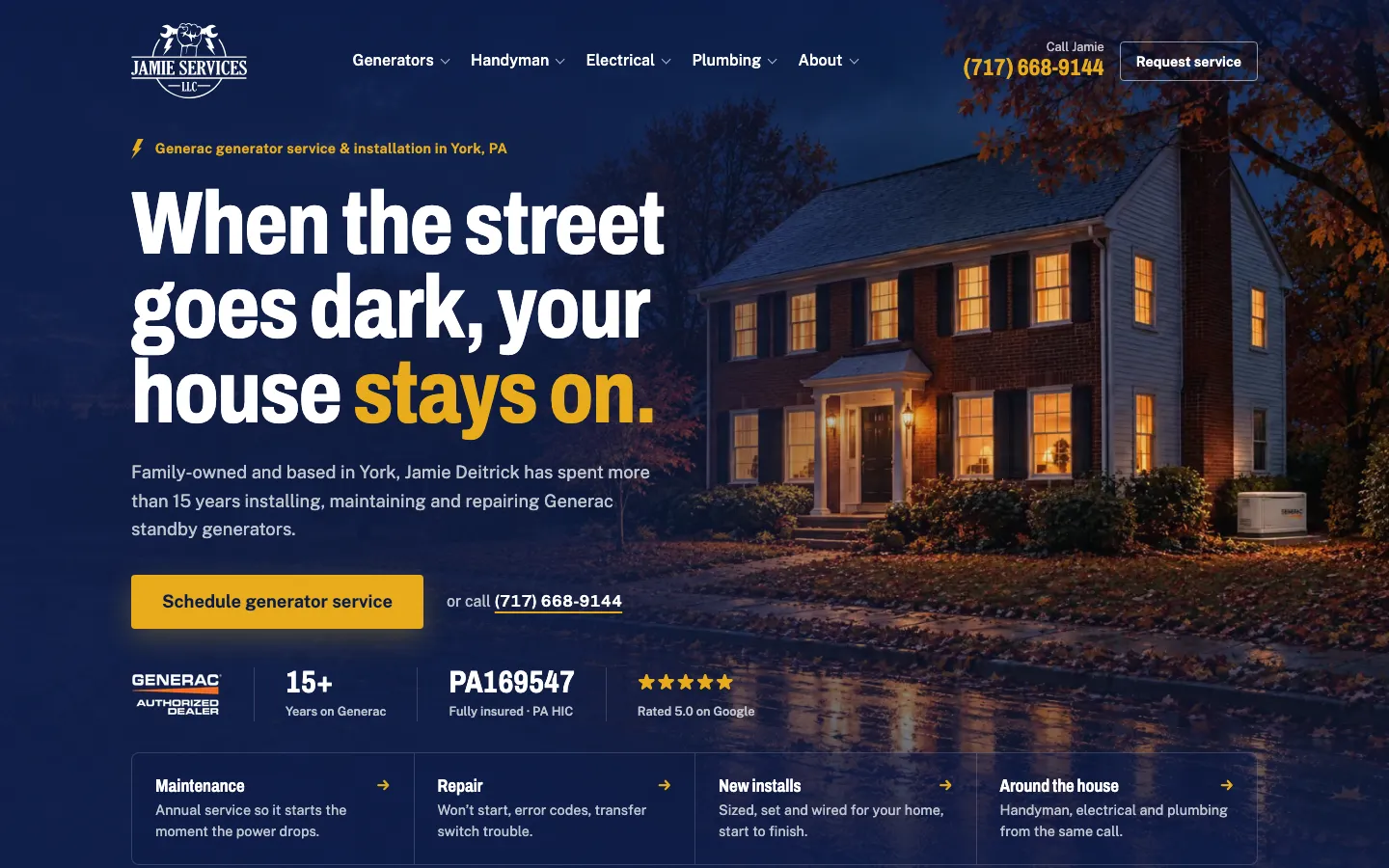
That website is freaking killing it. I got another lead from the site, 100%, and it panned out to an amazing repair.
Jamie DeitrickOwner/Operator, Jamie Services
Figures as of November 2026. Early results from individual sites, not a promise of what yours will do.
What a campground website from Summit Echo includes
Campground websites are read by planners: someone with a map open and a weekend in mind, comparing three parks. The pages below answer their questions in the order they ask them and link into the reservation system you already use.
Click the tabs to see this site before and after.
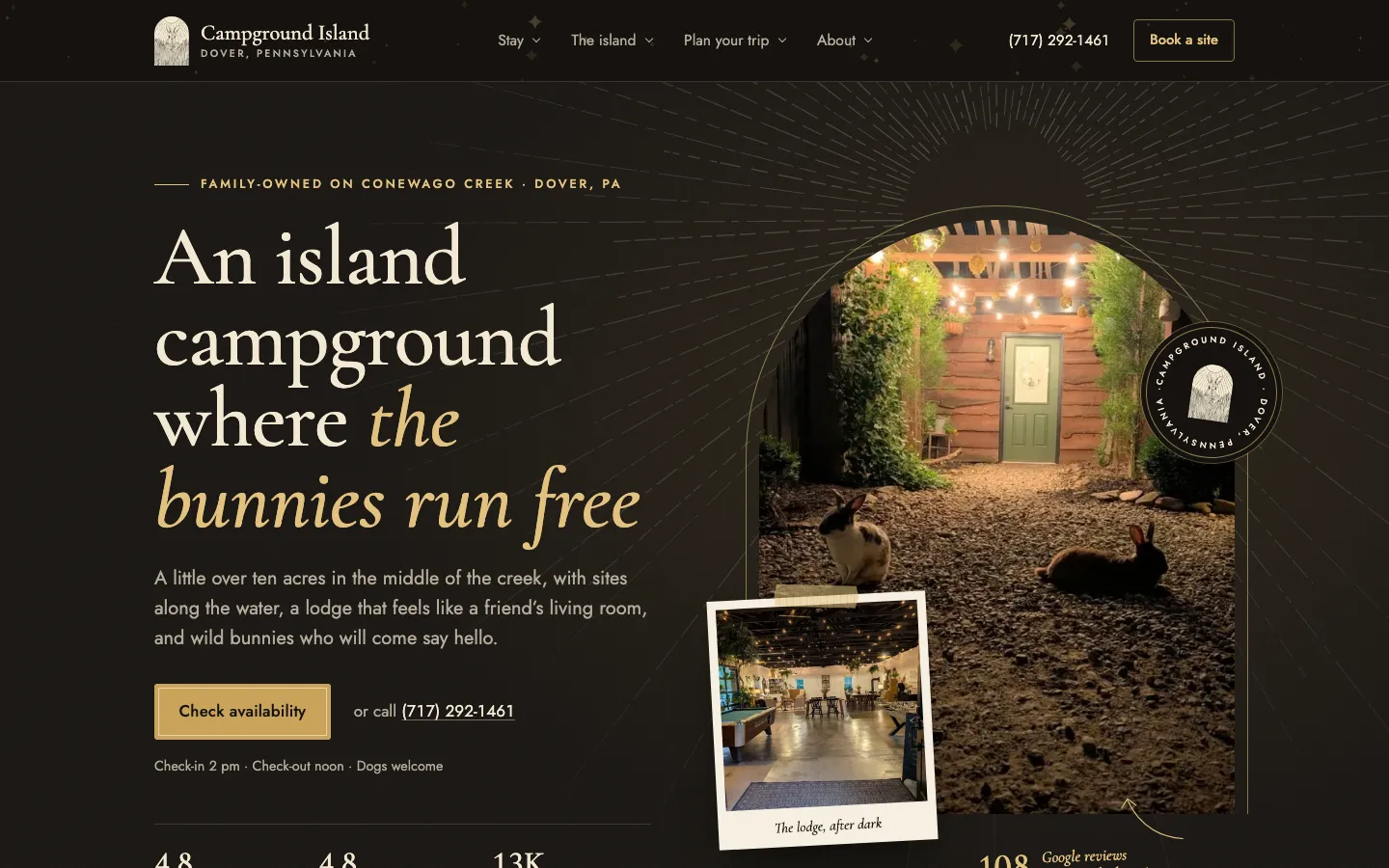
Real client · Campground Island · Dover, PA
What changed on this site
1
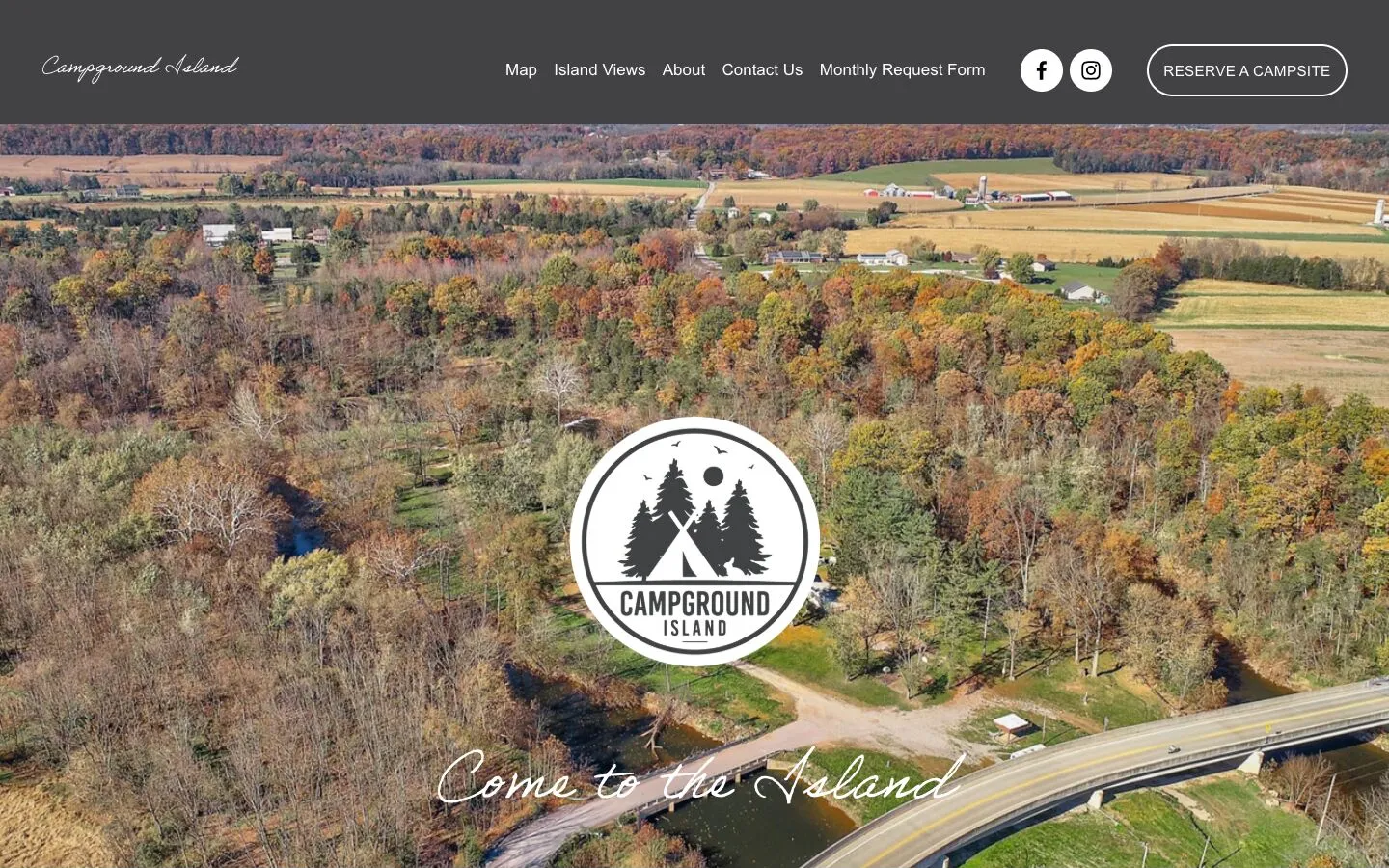
The old homepage was an aerial photo, the logo, and “Come to the Island” in script, and their Google reviews appeared nowhere on the site.
2
The new homepage opens with what makes the island different, waterfront sites on Conewago Creek and the resident bunnies, with Check availability into Campspot and their 4.8 Google rating from 421 reviews right under it.
3
The static site-map image is now an interactive map of all 70 sites that filters by site type, 50 amp, waterfront, and buddy sites, with a photo, rates, and a booking link on each one.
4
New pages answer how guests search, like camping near Gettysburg, Harrisburg & Hershey, and York, and every old Squarespace URL redirects to its closest new page.
The pages we write for you
Chosen with you at the start, around the services and towns that matter to your business. See the full Express plan.
01
Site types and hookups
RV full-hookup, partial, pull-through, tent, cabins, seasonal sites. Each explained with dimensions, amperage, and what it is good for.
02
Rates and seasons
Nightly, weekly, and seasonal rates as real text, with season dates. Updated as a basic content change when prices move.
03
Amenities and activities
Pool, bathhouse, store, Wi-Fi, playground, lake, events. What is there and what it costs, with honest photos.
04
Rules, policies, and check-in
Quiet hours, pets, fires, golf carts, check-in and cancellation. The page that saves your office fifty calls a season.
05
Park map and directions
A readable map, GPS-friendly directions, and big-rig notes for the last mile.
06
Local area and things to do
Nearby attractions, towns, and trips. The planning-stage pages that bring guests who have not picked a park yet.
How much does a campground website cost?
Campground owners pay for a website one of four ways. The sticker price is only part of it: the other part is who writes the pages, who fixes the form when it breaks, and who updates the rates and opening dates each season.
Do-it-yourself builder
$15–$50/mo
plus your nights and weekends
Cheap on paper, expensive in hours. Most owners spend weeks of evenings learning the builder, launch something "good enough," and never touch it again. Every hour spent on it is an hour not spent on the grounds or with your guests.
Freelancer or template build
$500–$3,000
up front, plus hosting
A few template pages, then hourly billing for every change after launch.
Campground marketing agency
$3,000–$12,000+
up front, often plus a retainer
Custom design and more pages, often with a monthly hosting or marketing retainer on top. Launch is commonly measured in months.
Summit Echo Express
$200/mo
no setup fee
We plan, write, design, build, and host the site, and make basic content updates while you are on the plan. Live within 10 business days after you send us your details.
Ranges for other routes are typical 2026 US prices, not quotes.
campgrounds near [lake or town]
RV park full hookups [area]
A page that answers the search
Exactly what they searched, in their town
Reviews · Details · Tap to call
A homepage that does not
Home | Quality Service You Can Trust
Welcome to our website…
How guests look for a campground
Searches start broad, then get specific
Campground searches start broad and get specific: "campgrounds near [lake or town]," then "RV park full hookups [area]," then your name once they have found you. The first two are won by parks whose sites explain site types and areas clearly; the last is lost by parks whose sites make the guest call to ask about rates.
Honest photos beat polished ones
Photos matter more here than in most industries, and honesty matters more than polish. A guest who books from stock photos and arrives to something different leaves a review. We build the gallery for your real photos and launch with tasteful placeholders until they arrive.
We write it from your rates and rules
We write the pages from your answers, your current rate sheet, and your rules, and we link into whatever reservation system you already use. Campground Island kept Campspot; every Check availability button on their new site goes straight into it.
Send us your details: the campground services you want more of, your towns or neighborhoods, credentials, photos, and reviews.
2
We plan, write, and build
We plan the pages, write them, design the site, and build the forms. You review before anything goes live.
3
Your site goes live
Live within 10 business days after you send us your details, with hosting and basic content updates included.
“
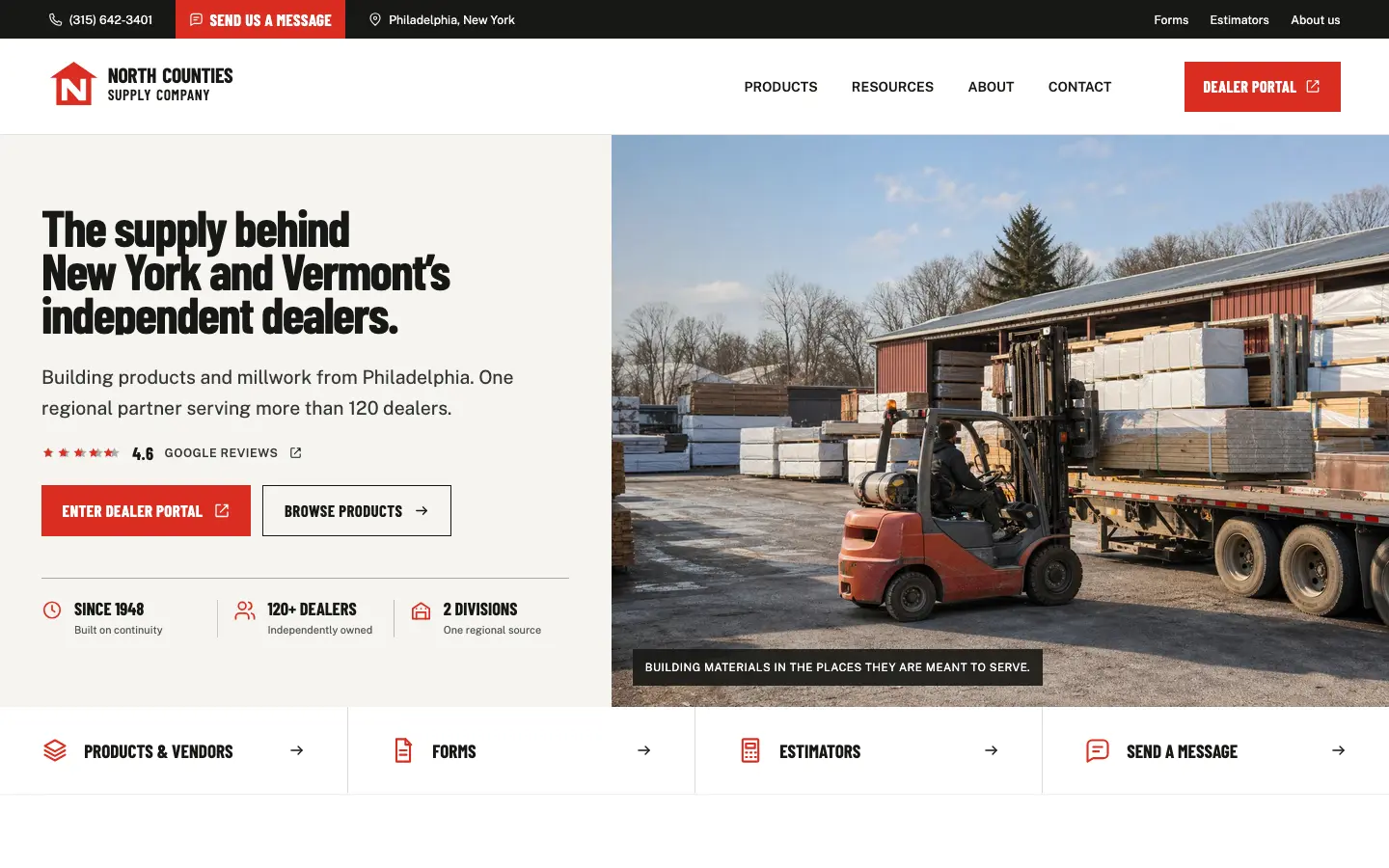
We’re getting a ton of feedback on how nice the new site is. That’s a good sign.
Walt PerryGeneral Manager, North Counties Supply
Reservation calls answered after the office closes
Weekend bookings happen on weekday evenings, when the office is dark. The AI Voice Agent answers the calls you send to it, answers availability, rules, and directions questions, takes reservation requests, and passes anything unusual to a person in the morning. $400/month on its own, month to month, or $550/month with the website as The Front Door.
Answers site type, rate, rule, and directions questions from the details you give us
Captures reservation requests with dates, rig size, and contact
Escalates to a person by rules you set at the start
A campground website typically costs $500 to $3,000 up front from a freelancer or $3,000 to $12,000 or more from an agency, plus hosting and fees for changes. A do-it-yourself builder runs $15 to $50 a month, but you do the writing and upkeep. Summit Echo's Express Website is $200 a month with no setup fee, with planning, writing, design, hosting, and basic content updates included. There is a 6-month minimum, then it is month to month.
We use Campspot / Newbook / RMS. Does the site replace it?
No. The site links into the reservation system you already use and puts that link on every page. Nothing about how bookings are taken changes.
Can rates and season dates change without a redesign?
Yes. Rates and dates are text on a page, and changing them is a basic content update, included on the plan.
Our photos are not great.
We launch with tasteful placeholders and swap in your photos as you send them, as a basic content update. Phone photos taken on a clear morning are usually enough; honest beats glossy for campground guests.
How fast will the site be live?
Within 10 business days after you send us your details. Checkout comes first and does not start the clock; the questionnaire does. Most owners finish it in an evening.
What if my services or towns change?
Basic content updates are included while you are on the plan. Send the change through your client portal and we make it. Adding a new service page or a new town page is a normal request, not a change order.
Do I own the website?
Express is a managed website subscription, not a one-time website purchase. You own your domain, trademarks, logo, customer data, and the original materials you give us. Summit Echo owns the assembled website, design, copy we write, code, templates, hosting setup, and search and AI optimization work, and licenses it to you while your subscription is active.
What happens if I cancel?
Cancellation takes 30 days’ written notice, given in your client portal, and becomes effective on the later of the end of the initial 6-month term or 30 days after notice. Your site stays live and billing continues through that date; after it, the site is unpublished. We do not export, package, or migrate the site, its design files, or code. Your domain is released or transferred to you, and you can download available customer data through your existing tools before service ends. We keep a backup for 60 days in case you want to reactivate, then delete it permanently.